

A candidate pauses, looks away from the webcam and gives a polished answer. The recruiter suspects they are reading from an AI assistant. But the same recording could show someone checking permitted notes, thinking through a difficult question or looking at a second screen that holds the interviewer’s face.
That ambiguity is the central problem interview fraud detection software needs to address. Finding unusual behaviour is only the beginning. A useful system should help a hiring team understand what happened, locate the relevant part of the recording and decide whether the evidence justifies a follow-up.
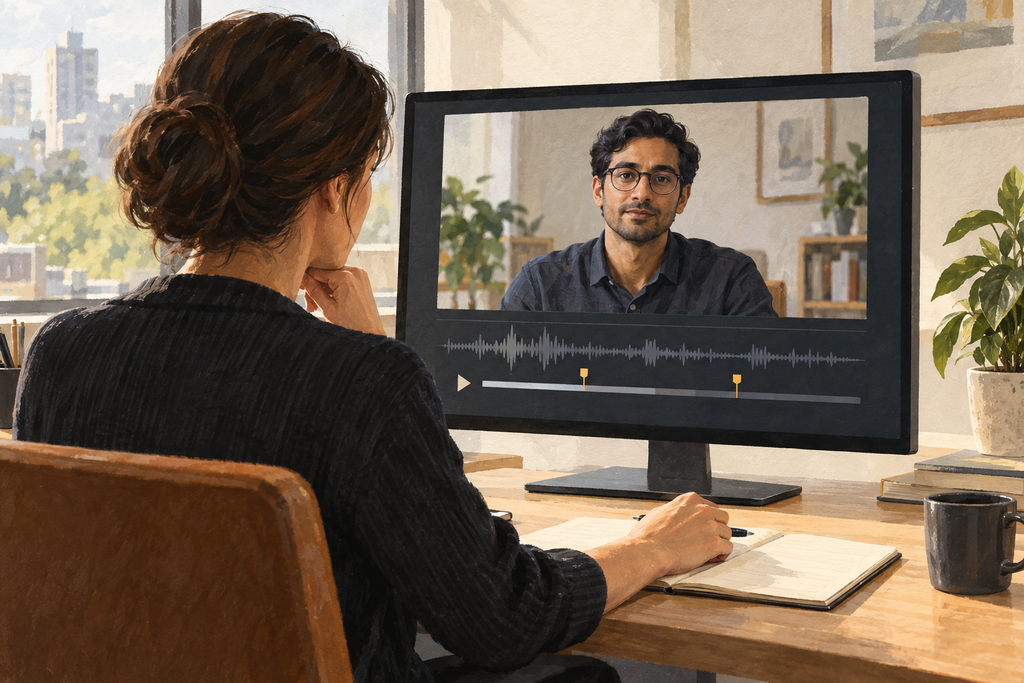
Illustration of a recruiter reviewing a recorded interview. The interface is illustrative.
For recruiters evaluating this software, the most revealing question is simple: can you explain why an individual answer was flagged?
Interview fraud covers more than AI-written answers. Someone may receive prompts from another person, have a substitute attend an interview or misrepresent their identity. In June 2022, the FBI’s Internet Crime Complaint Center warned about complaints involving stolen personal information and potentially synthetic voices in applications and interviews for remote jobs. That warning documents a real problem. It does not tell an employer how common fraud is among its own applicants.
Different risks call for different evidence. A transcript may contain wording worth examining, but it cannot show whether a different person appeared on camera halfway through the interview. Video may show a candidate reading off-screen, but it cannot establish whether the material was forbidden. Before comparing products, identify the behaviour you need to investigate and the information needed to assess it.
The interview rules also need to be clear. If candidates may use documentation during a technical exercise, consulting it should not automatically become evidence of cheating. If the exercise requires unaided answers, say so beforehand. Explain the rules for notes, AI assistants, outside help and any agreed accommodations. A detector cannot resolve an unclear policy.
Consider this hypothetical example. A software engineering candidate is asked to explain how they would investigate a slow database query. They pause for several seconds, glance to the side and deliver a well-organised answer. An AI interview cheat detection system flags the response.
The recruiter should first review the full question and answer rather than a short clip of the glance. Was the candidate looking toward the screen throughout the call? Did they mention using permitted notes? Was there an interruption? Does the flagged wording identify a specific concern, or does the report merely describe the answer as sounding like AI?
A useful follow-up might be: “You mentioned adding an index. What would you check before deciding which columns to include?” Another could ask the candidate to explain a trade-off in their own example. These questions examine their reasoning and job knowledge. A weak answer can inform the skills assessment, but it does not, by itself, establish that the earlier answer was fraudulent.
The report should make this review straightforward. Look for a precise time window, the relevant question, the observed behaviour and an explanation of the concern. It should distinguish something visible in the recording, such as a second person entering the frame, from an interpretation, such as suspected coaching.
Multiple signals can provide useful context when they relate to the same answer. Suppose a candidate repeatedly looks toward an off-camera source, a second voice is audible during those moments and the answers follow immediately afterward. That deserves closer examination. It still matters whether the voice belongs to the interviewer, a household member or an approved participant. Several flags generated from the same ambiguous event should not be treated as independent proof.
This is a relevant distinction when reviewing HeyMilo Red’s product description. The company describes analysing recorded interviews across video, audio and transcripts, followed by a second review that confirms or removes flags. Its listed checks include suspected AI-generated responses, off-screen reading, external voices, identity changes and face-swap deepfakes. Reports include time windows, severity, evidence and a recommended action.
That describes the product’s intended workflow, not an independent assessment of its accuracy. A buyer should still ask to see how the system handles an ordinary interview with pauses, background noise and permitted reference material. The valuable demonstration is one where the reviewer can understand why a concern was retained or dismissed.
Ask providers what their accuracy figures actually measure. How many recordings were tested? Who established whether cheating occurred? Were legitimate interviews included, and how many were incorrectly flagged? Did the test cover different recording quality, languages and interview formats? Results from a carefully staged demonstration may not describe performance on your team’s calls.
If a provider presents a single accuracy percentage, request the underlying counts. As an illustrative example, imagine 100 interviews containing five confirmed cases of cheating. A system flags all five but also flags ten legitimate interviews. It found every known cheating case, yet only five of its fifteen flags identified cheating. For the recruiter reviewing those reports, that difference has practical consequences. These figures are an example, not a performance claim about HeyMilo Red or another provider.
The same scrutiny applies to a “clean” result. Ask whether the software completed every intended check and whether poor audio, missing video or an incomplete transcript limited the assessment. No detected issue is different from an interview that could not be assessed properly. The report should make that distinction visible.
During a pilot, keep a record of the concerns the software raises and the outcome of each human review. Separate confirmed policy violations from unresolved suspicions and harmless events. Also track how long reviews take. A system that produces many unexplained alerts may create more work than it saves, even if processing the recordings is quick.
Give reviewers a consistent procedure. They should check the interview rules, watch the flagged segment in context and record why they accepted or dismissed the concern. Where the evidence remains ambiguous, use an appropriate follow-up rather than turning a score into an automatic rejection. Candidates should have a way to explain circumstances relevant to the finding.
Recorded interview analysis also raises practical questions about access and retention. Before adopting a product, establish who can view recordings and reports, how long they remain available and how deletion works. Tell candidates how recordings will be used. These decisions belong in the implementation plan, alongside the hiring team’s normal privacy and security review.
Interview fraud detection software is most useful when it leaves a recruiter with a specific, reviewable concern. “Possible external prompting during the answer to question four” gives someone a place to start. “This candidate seems suspicious” does not.
When evaluating HeyMilo Red or another provider, ask to review a complete report beside the original recording. Follow one flag from detection to the final explanation. Then ask what would cause the system, or your own reviewer, to dismiss it. That exercise reveals more about the software’s usefulness than a list of detection features alone.
The HeyMilo Red product page explains its recorded interview analysis workflow: https://red.heymilo.ai/product
